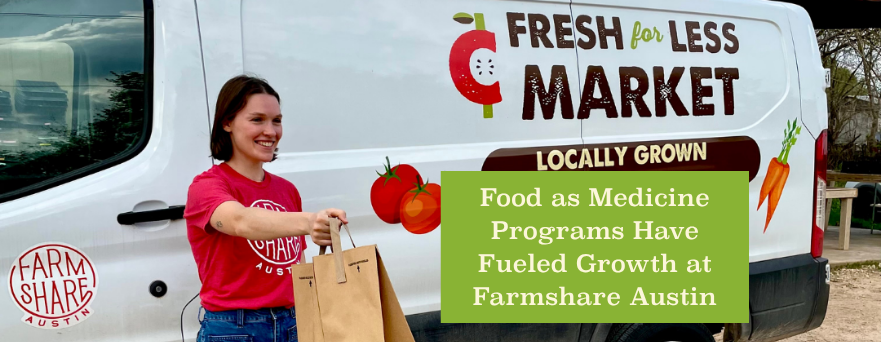
Food as Medicine has been a winning prescription for Farmshare Austin. The Texas farm and food hub can attribute nearly its entire YOY sales growth in the home delivery program to these initiatives. Food as Medicine also gives the organization a new approach for meeting its mission, an avenue to form meaningful partnerships, and a way to recruit long-term customers.
So far, Farmshare Austin has successfully participated in several one- to two-year Food as Medicine pilot programs, but Food Access Director Alicia Fischweicher believes Food as Medicine has the potential to become a more permanent part of the organization’s services. A changing healthcare system that is more focused on preventative health means programs like these are likely to grow. Local farms and food hubs, which can provide the nutrient dense foods participants need, are in a strong position to profit from the growth in Food as Medicine programs. Keep reading to learn more about Farmshare Austin’s success.
Farmshare Austin’s Food is the Best Medicine Program Served More Than 350 Households
Farmshare Austin is a 13-acre organic farm and food hub focused on growing a healthy, just, and equitable local food system by increasing community food access and cultivating new farmers in central Texas. The farm has been involved in three Food as Medicine programs in the past three years.
Food is the Best Medicine, supported by the Ascension Seton Foundation and the Michael and Susan Dell Center for Healthy Living at the UTHealth School of Public Health, focuses on food-insecure birthing parents. Participants receive a box of mixed seasonal and staple produce items along with pantry goods.
Participants also receive prepared meals and meal kits as part of the program, which are delivered at the same time as the farm boxes. In the beginning, those were provided by a private business called The Cook’s Nook. Now, the meal kits and prepared meals come from the Central Texas Food Bank. Since 2023, the program has served 369 households.
Interested in learning more about how Food as Medicide programs can benefit local farms and food hubs? Download your free guide!
Download the GuideVeggieRx Becomes Produce and Pantry Prescription
Farmshare Austin’s second Food as Medicine program started as a one-year pilot funded by USDA. VeggieRx provided vouchers for fruits and veggies to people diagnosed with diabetes or pre-diabetes. After a successful pilot, Farmshare and its partners (including Dell Medical School at the University of Texas-Austin and Lone Star Circle of Care, a federally qualified health center) pivoted to focus on youth with chronic diet-related health conditions. Participants can use a card with their individual program ID number to purchase produce and pantry items. This new program is known as Produce and Pantry Prescription (PPRx) and offers an indexed benefit based on family size.
Fischweicher said the new program was successful right out of the gate. “The first Veggie Rx program was successful, but it took a minute for it to start gaining traction. PPRx had 100% usage right off the bat.” The Mobile Market at Lone Star Circle of Care has seen a 122% increase in sales in the first month after it started.
She attributes the rapid adoption of PPRx in part to its focus on children — families may be more likely to make a change if it benefits their kids, even though the whole family is likely to see better health outcomes — and in part to the growing interest in Food as Medicine programs.
The culture and climate for Food as Medicine has improved over the last few years. It seems obvious to me and a lot of people that what you eat very directly affects your health, but it’s taken a long time for healthcare institutions to recognize that. Now, there seems to be more of an interest in preventative health care, and it’s helping our programs and other similar programs gain traction.”
—Alicia Fischweicher, Food Access Director at Farmshare Austin
Why Food as Medicine Makes Sense for Farmshare Austin
Fischweicher credits Food as Medicine programs for helping Farmshare Austin meet multiple goals. In the beginning, the Veggie Rx program was a natural extension of the farm’s Mobile Markets, which are strongly tied to its mission of improving local food access.
“Many of our markets are located at federally qualified health centers, so we have a strong relationship with them,” Fischweicher said. “Food as Medicine became a way to further enmesh ourselves with these health care systems to get food to people who need it the most.”
Food as Medicine programs have now become an important source of income for Farmshare Austin. The organization’s partnerships put it in a strong position to apply for grants, which cover staff time and the cost of the farm boxes.
It’s been really nice for us to have consistency in knowing we’re enrolling 50 or 100 participants in the program and we’ll have that reliable business for the duration of the program.”
—Alicia Fischweicher, Food Access Director at Farmshare Austin
Perhaps more importantly, many of Farmshare Austin’s Food as Medicine customers turn into long-term buyers.
We often find that once the program is over, we gain some new customers who want to continue using our services. That’s another thing that benefits Farmshare is the exposure to a new or different market of people who would benefit from having affordable, reliable, healthy foods.”
—Alicia Fischweicher, Food Access Director at Farmshare Austin
Looking forward, Fischweicher aims to move Farmshare Austin’s Food as Medicine programs from short-term pilots to a permanent fixture in central Texas. “What I’m hoping for is long-term relationships with our clinical and evaluation partners so we can have a greater impact on the health outcomes of the individuals being served,” she said. That change will also have a permanent and positive impact on the organization’s bottom line.
Learn More About Food as Medicine Programs
Are you interested in more details about Farmshare Austin’s program and how Food as Medicine programs can help your farm or food hub? Attend our free live event, “Farms and Food Hubs: How to Build a Food as Medicine Program,” on Tuesday, November 11 at 11 a.m. PT.
 View the webinar
As interest and support for Food as Medicine programs increases, organizers are rethinking where they source their food, and there is a growing movement toward purchasing local food as much as possible. We see a real opportunity for farms and food hubs to get more involved in these efforts.
In this free session, we discussed what you need to know about Food as Medicine programs. Here’s what you’ll learn:
🌟 What Food as Medicine programs are and why they represent such a great opportunity for food hubs and farms looking to sell more and expand their community partnerships.
🌟 How to identify and evaluate Food as Medicine programs to see if they make sense for you.
🌟 Best practices for running an effective program, including maintaining good communication with partners and finding sustainable funding sources.
Speakers included:
🌟 Alicia Fischweicher, Food Access Director at Farmshare Austin
🌟 Brent Ling, Interim Director (Executive), Director of External Affairs at Wholesome Wave
🌟 Julie Barlow, Director at FreshRx Oklahoma
🌟 Stefanie Jaeger, Director of Sales and Customer Success at Local Food Marketplace